
Before the Fabric Adoption Roadmap, Run the Step-Zero Test
July 27, 2026 · Tommy Puglia

A partner of mine is helping two companies through a merger. Two workforces about to become one. He suggested a dashboard showing staff utilization. Leadership’s response? What a great idea. It had not crossed their minds.
How do you not think about that as an executive?
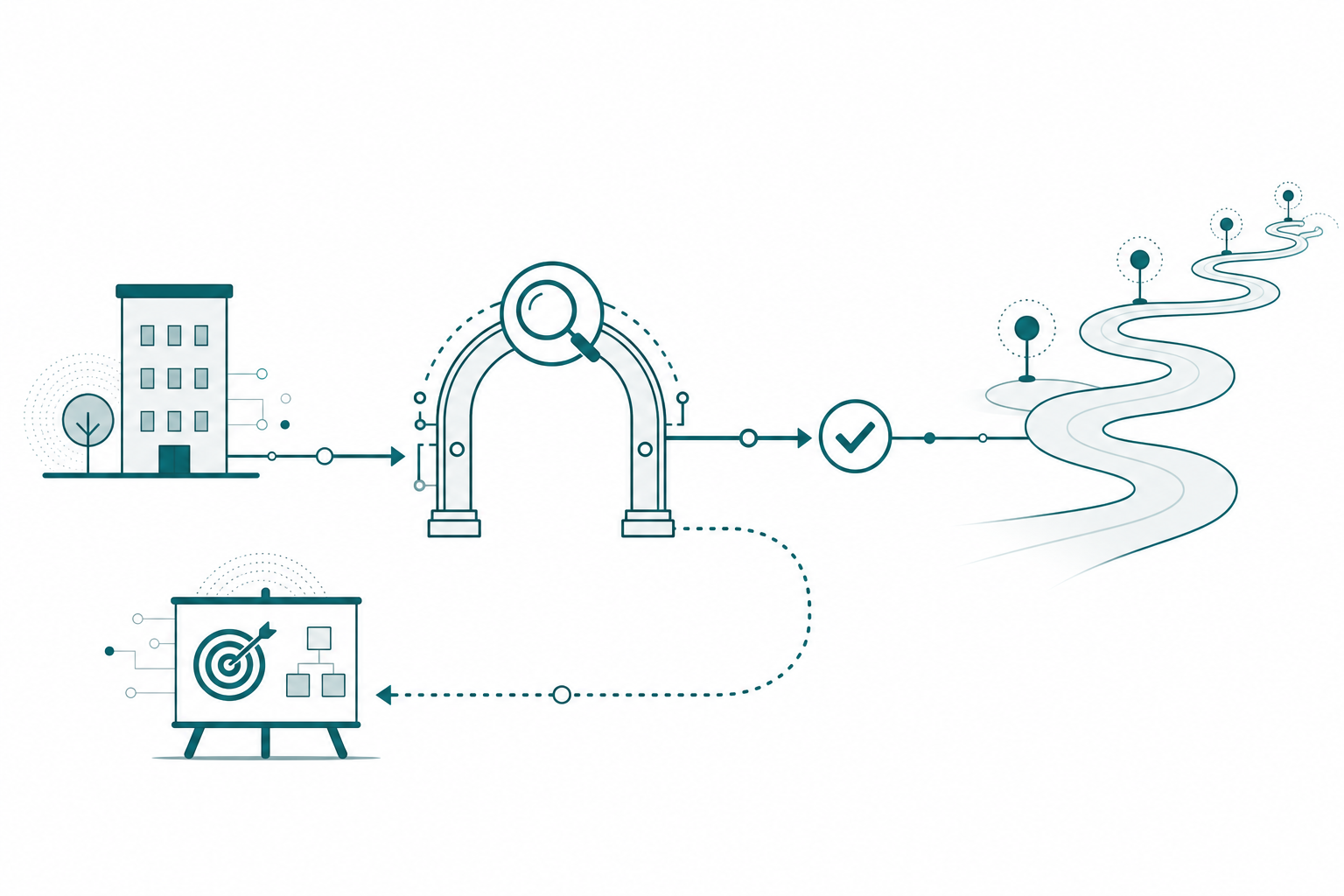
I keep coming back to that question, because it explains why so many adoption programs go nowhere. My position is simple: adoption frameworks and governance programs fail at companies that never defined what they measure. So before any roadmap, run what I call the step-zero test. Does leadership have real objectives and key results, with defined measures of success for every team? If the answer is no, stop. No framework can help you yet.
The Roadmap Is Step One. Step Zero Comes First.
Let me be clear about what I’m NOT saying. Microsoft’s Fabric adoption roadmap is genuinely useful guidance. It gives you a published standard to baseline against, from governance to data culture. And per Microsoft’s own guidance, the number one success factor for Power BI is an executive sponsor who understands it and puts resources behind it. I don’t argue with any of that. Is the roadmap good? Of course it’s good. That was never the problem.
The problem is that the roadmap is step one. And a lot of companies are not ready for step one.
Step zero is a blunter question. Does this company even have OKRs, or some semblance of them? Not a mission statement. Not a slide that says “growth.” Actual objectives with key results that real people are measured against. Here’s what I’ve found: companies that never bought into analytics usually never bought into expectations around what they’re measuring in the first place. The dashboard problem is downstream of the definition problem.
“We Want Sales to Go Up” Is Not an OKR
“We have a KPI. We look at sales. We want sales to go up.”
That’s not an OKR. That’s a wish. Nobody owns it, nothing downstream can act on it, and no report can support it.
A healthy company understands two things before any infrastructure conversation happens. It knows the metrics that matter to the company, and the metrics each team needs to do its job. Every person can answer: what am I measured against? And what does my team need to accomplish for the company’s goal to happen?
I know, I know. This sounds like your Business 101 course. But get out into the real world, my friend, and an uncomfortable number of companies are failing at it.
Notice what the test never asks about: technology. It’s completely technology-agnostic. If a company passes, the answer could even be SSRS (yes, really). When leadership knows exactly what success means and every team knows what supports it, the tooling is a detail. And if a company fails? No amount of Fabric capacity fixes it. That’s what makes it a diagnostic. It tells you whether the expensive treatment will even take.
It’s also why I struggle when governance is the FIRST conversation. If leadership never asks “what are we measured against,” how in the world are we going to introduce governance to them? Certified datasets and endorsement policies for metrics nobody defined? That’s organizing the library for a company that hasn’t learned to read. The shelves are labeled. The catalog is immaculate. And not one person in the building can read a book.
Bending the Knee
Early in my Power BI career, my team had a literal rule: we’re not doing everything for everyone, but if the request comes from someone whose title starts with a C, you just say yes and do what they ask. Bending the knee to the C-level was policy.
Plenty of those executives were great. A few made asks that had nothing to do with business value. At one point an executive wanted a report and specifically wanted it in SSRS. The request landed on a junior developer who didn’t know SQL yet, and who spent three nights in a row at the office building it, because that’s what the executive wanted. (SSRS is not the villain here. A demand with no value attached is the villain.)
Two failures live in that story. An executive who doesn’t speak data, making a technology demand instead of a value demand. And a team with no standing to push back. Could we have said no? Please. I can’t just tell an executive no, and neither can you. Without an agreed set of goals to point at, “no” isn’t available. Neither is “how does this support what you’re trying to do?” All that’s left is yes, and three nights at the office.
That’s the real cost of skipping step zero: a BI team burning its best hours on requests that were never connected to anything.
Why Executives Don’t Speak Data
When leadership and BI teams talk past each other, I look at four areas.
- Data culture: the defined set of expectations. Where do we go to find data? Who is responsible for what? What do we rely on?
- Data literacy: the ability to read data and know what to ask for. I can define my metrics, so I can communicate them. Sales leads, marketing leads: we all agree on what those words mean.
- Cognitive load: every new visual and every new metric taxes your audience. Introduce a running total and people have to process what it represents and why it matters. Executives feel that tax more than anyone, and they’ll never tell you.
- Buy-in: we actually believe in the power of data, and we are going to use it.
Those four together are what elevate an executive team. And here’s the uncomfortable part for those of us who love grassroots adoption: Power BI can come from the bottom up, but real success comes from the top down. You can build the best semantic model in the tenant. If the people at the top never defined what winning means, you built it for an audience that can’t hear it.
The First Time I Saw It Work
Everything changed for me at the first company I worked at where the data culture actually matured. The shift wasn’t a tool. It was a habit: the company defined its goals for the quarter and the year, and the only projects we worked on were the ones aligned to one of those goals.
That single habit rewired every conversation. The question stopped being “who asked for it?” and became “how does this support the goal the company is trying to hit?” Someone in marketing wants a report of every email and every subject line to help increase emails. Sure, we CAN build that. But if it doesn’t support what marketing is actually trying to achieve, what are we doing?
That question, asked consistently, is what speaking the same language actually looks like. Not executives learning DAX. Alignment.

The Step-Zero Playbook
Enough diagnosis. Here’s how I would actually run this at your company, starting this week. None of it requires budget, a committee, or a single new license.
1. Score the company on four questions
Quietly and honestly, before any roadmap conversation, answer these. Not what the company SAYS about itself. What you can actually observe.
- Does the company have defined goals for the year or the quarter, beyond a number that should go up? A pass means a leader can recite them without pulling up a deck.
- Can each leader say what they are measured against? A pass is a specific answer in one sentence. “Performance” is not an answer.
- Can each leader say what their team must accomplish to support those goals? A pass means they can name their team’s contribution without checking with their boss first.
- Can your BI backlog trace each request back to one of those goals? A pass means more than half of your open requests connect to something a leader would recognize as a goal.
Four yeses? Congratulations, run the roadmap and go all in. Two or three? Run the roadmap, but treat the gaps as first-class work items, not footnotes. Zero or one? Stop. The roadmap can wait. You just found the real project.
2. Run the “what keeps you up at night” conversation
When I sit down with an executive, I ask exactly that: what keeps you up at night? Now we can talk the same language, because I know what bothers them and what they’re trying to do.
Don’t stop at the first answer. Here are the follow-ups I lean on:
- “If that got better, what number would move?”
- “Who on your team owns that number today?”
- “Of the reports we’ve built for you, which one actually helps with it?”
Write the answers down. Their words, not your translation. You will need them verbatim later.
And brace for the disconnect. They’ll name the thing giving them agita, then ask for 18 reports that are just shortcuts, none of which touch it. Don’t get cynical. The gap between what they fear and what they request is your work list.

3. Audit your own backlog
This one takes an hour and produces the single most persuasive artifact in the whole playbook. Pull your last ten report requests. Make three columns: the request, who asked for it, and the company goal it supports.
Now look at column three. Every blank cell is evidence. When you go ask for buy-in, you’re not walking in with a philosophy; you’re walking in with a list that says six of our last ten requests connect to nothing anyone is measured on. That’s a conversation an executive can’t wave away.
4. Get buy-in, in the right order
Do not go roguely meeting with the CFO on your own authority. That’s how this dies. Talk to your boss first, and your boss’s boss if there is one, and frame it as a company initiative, not a BI project: “we’re aligning our reporting with the goals of the company.” Now you’re not randomly booking meetings with leadership; you’re running a program. And I guarantee executives have their own pain points with reporting today. This is a win-win, and you’re offering to fix their problem, not create a new one.
5. Keep the cadence
Send a progress update every two weeks to everyone in the conversation, especially the C-level. Keep it to four bullets: what we heard from leadership, which reports we connected to a goal, which requests we retired or paused, and what we need next. No charts required (yes, I’m telling a BI team to send an update with no visuals; the discipline is the point). Those goals become the BI team’s goals, and the updates prove you meant it.
6. If the company fails the test, start with one team
A failing grade doesn’t mean you sulk in the corner until leadership finds religion. It means you shrink the scope. Pick the ONE leader who came closest to passing, the one who could almost articulate what their team is measured on. Sit with them, define their measures of success, and rebuild their reporting around those measures and nothing else. Then let that team become the reference story. Alignment spreads by example, not by mandate. One team that can say “every report we have maps to a goal” is worth more than a governance deck nobody reads.
Do this right and the payoff is real: the BI team stops being the people who build apps. You become a strategic part of leadership doing their job. That buys authority, a little more budget, and leverage. Skip it and you’re swimming upstream indefinitely.
My favorite way to gauge progress costs nothing. Walk to get your coffee. If you pass a leadership meeting and they’re gathered around a Power BI dashboard, you’re on the right track.
Start Before Step One
Our industry loves frameworks because frameworks feel like progress. Print the roadmap, book the workshops, schedule the assessment. Alignment is harder and less glamorous, which is exactly why it gets skipped.
So run the test before the roadmap. If your company passes, the roadmap lands on fertile ground; go all in. If it fails, you just saved yourself a year of governance theater, and you know exactly where to start instead.
Takeaways
- The Fabric adoption roadmap is step one. Step zero is whether leadership has real OKRs with defined measures of success for every team.
- “We want sales to go up” is a wish, not an OKR. Nobody owns it, and no report can support it.
- The step-zero test is technology-agnostic. Pass it and even SSRS can work; fail it and no amount of Fabric capacity helps.
- Score the four questions honestly: defined goals, leaders who know their measures, teams that know their contribution, a backlog that traces to goals.
- The one-hour backlog audit (request, requester, goal it supports) is your most persuasive artifact. Blank cells are evidence.
- Get buy-in through your boss and frame it as a company initiative. Then keep a two-week update cadence to prove you meant it.
- If the company fails the test, don’t mandate. Pick one team, define their measures, and let the reference story spread.
Here’s my prediction. Building reports keeps getting faster and cheaper; with AI in the mix, a report will soon cost less than the meeting about it. When building costs nothing, the only durable advantage left is knowing what to measure and why. So this week, ask one executive a single question: “What keeps you up at night?” Write down the answer, pull their last three report requests, and check whether even one connects to it. That gap is your step zero, and it’s where the real roadmap begins. Keep the conversation going with us on the Explicit Measures podcast, and subscribe at PromptingBI for more.