
Agent Skills Give the Power BI Pro Room to Think
October 7, 2026 · Tommy Puglia
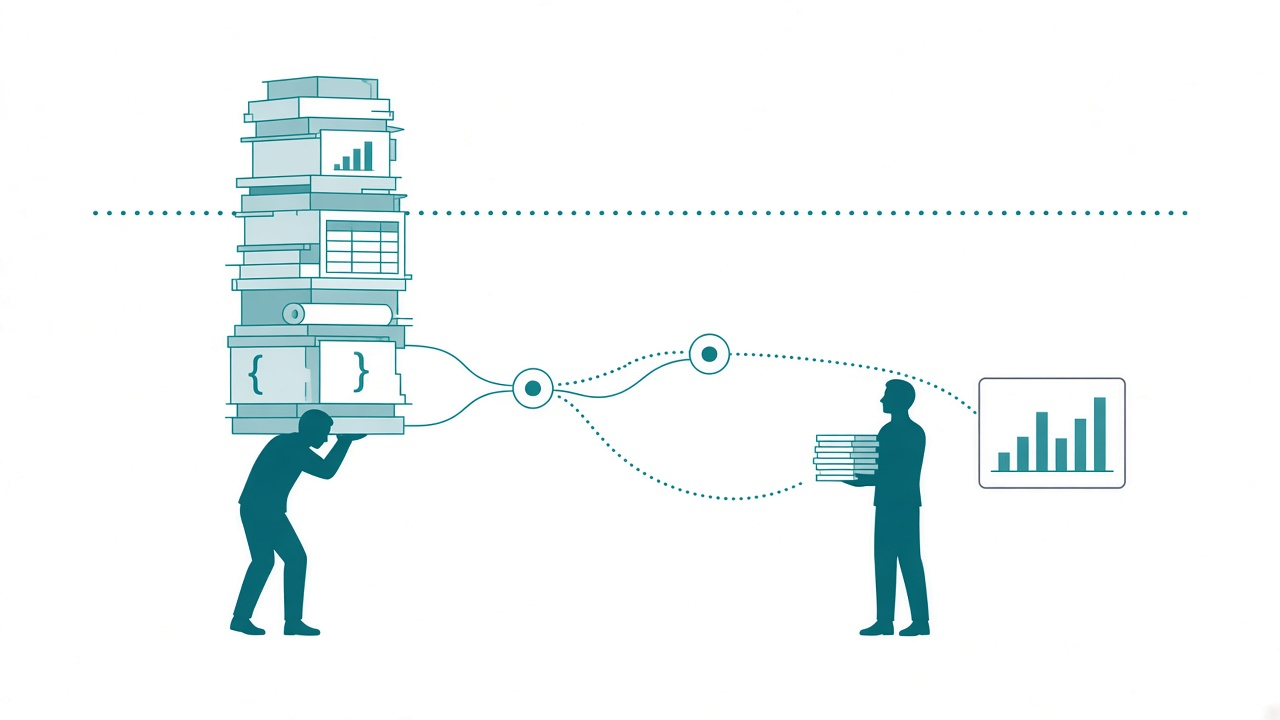
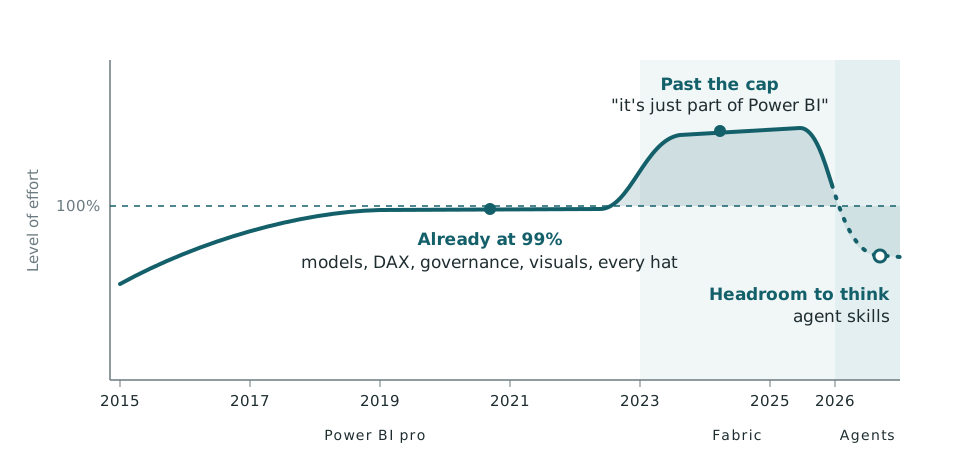
Grab a piece of paper and draw a graph. The y-axis is your level of effort at work. Draw a dashed line across it at 100%, the most one person can give. Now put a dot where you were as a Power BI professional in 2019.
I can’t count how many people from user groups and my own network have given me the same answer, and I’m one of them. The dot goes at 99%.
That number is where the AI-and-identity conversation should start. My view: the Power BI niche was too big long before AI showed up. Fabric pushed it past the cap, and nobody split the role. 2026 is the first year I can remember where a Power BI pro might get some headroom, because agent skills take real execution off the desk.
The effort is still there. It moves from typing to thinking, and the thinking was always the part worth paying you for.
Every hat, one person
From roughly 2015 to 2020, “Power BI pro” was the identity if you worked in data on the Microsoft stack. To become an MVP or a consultant, or to get promoted, you had to know Power BI. It meant DAX, Power Query, semantic modeling, dashboard design, and governance. The real unicorn could do all of that and also understand the business.
That list is at least five jobs.
One person can’t manage an entire business’s data, and a lot of us were quietly asked to anyway, because from the outside it was “just Power BI Desktop.” Behind that app name you ran the models, the governance, the measures, and the visuals for whoever needed them that week.
We were a little proud of it. I was. Wearing every hat felt like job security, and touching every part of the business was fun. It also left zero slack. At 99%, there’s no room for the next thing.
And the next thing showed up.
Fabric went to the same person
Leave AI out of it for a minute. Fabric alone pushed the role over the line.
Most organizations adopting Fabric don’t come from a data engineering background, and now they’re learning medallion architecture, notebooks, and pipelines. I don’t think many of them planned to split roles and hire a data engineer for Fabric. That conversation is happening now, and it’s why I think central BI should work like a tiger team. At launch, the message was: you’re already in Power BI, and this is just part of Power BI.
That was the misconception. Fabric isn’t Power BI 2.0. For a lot of what lives in a lakehouse or a pipeline, your Power BI experience maybe helps 5%.
Someone should have asked out loud: am I going to make everyone learn that? The other option was giving the lakehouses and pipelines to someone whose job that is. Most places never asked. They handed all of it to the person already at 99%.
That’s the spike on the graph. Past 100%, with the stress landing on individuals while the org charts stayed the same. I don’t like the word “threatened” for what happened to the Power BI identity, but Fabric rattled the cage. It got much harder to say “I’m just a Power BI person” and mean it as a full job description.
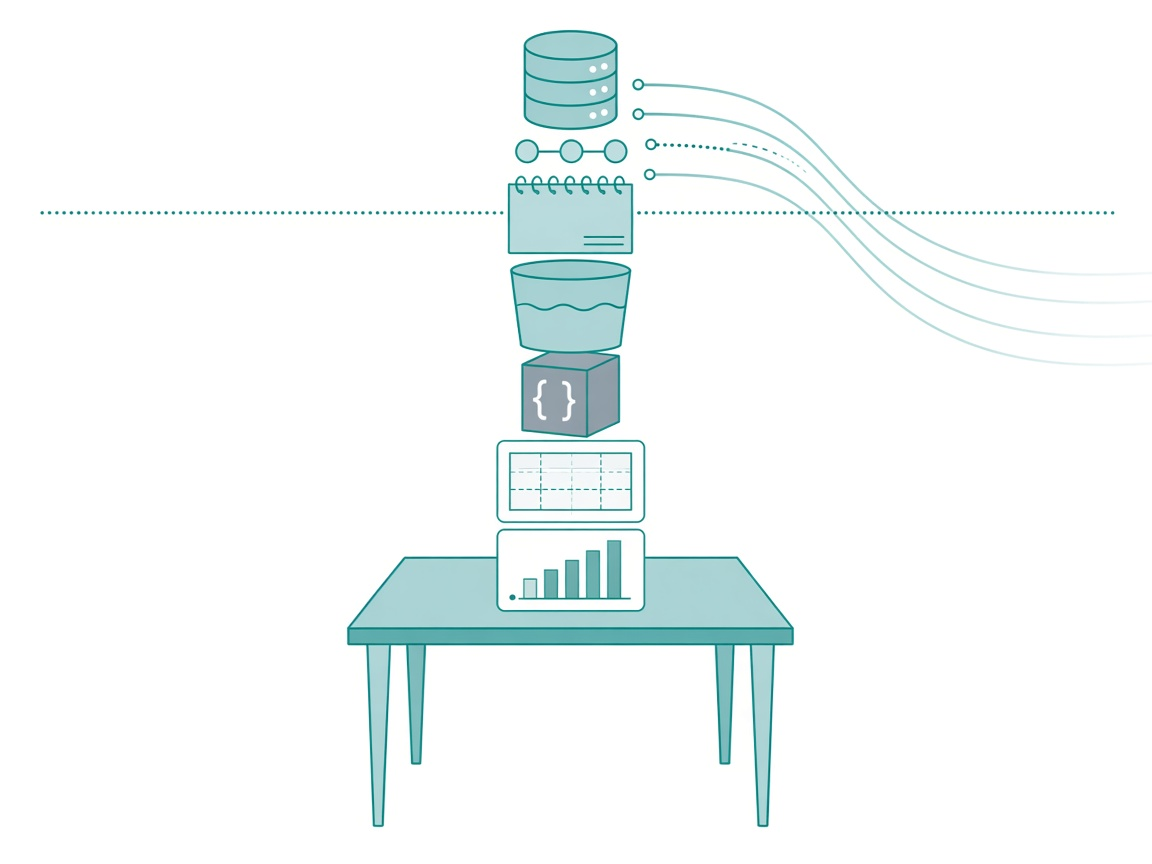
The access gap made it worse. If you’re independent, you can spin up Fabric and agents whenever you want and build the experience. I hear from plenty of people whose companies won’t buy Fabric, and they get penalized on Fabric experience for a decision they never made.
Headroom in 2026
This is the part I’m optimistic about. With agent tooling, a Power BI pro can finally see the line come back under the cap. The job is the same size. A real chunk of the execution can now be handed off.
Here’s a normal example. I had two project folders where I’d overcomplicated things, and I wanted a single semantic model. I pointed an agent at both folders, told it that, and it was done. I don’t know how long that would have taken me by hand. On a team, that’s the difference between a two-month project and a one-week one. The people still have the skill, and they get to work on other things.
Agent skills make that handoff work. A skill is the instructions and context you give an agent so it builds the way you would. The mechanical part of the Power BI pro’s job, the part that ate the hours, is what a good skill carries. I’ve written about why a skill.md is not wisdom and why a team’s skills can’t live in one head, and both still hold. The headroom side gets less attention. Skills are the first tool in a decade that takes hats off the Power BI pro.
They help with the access gap too. You may not get Fabric approved at work, but you can build agentic work on your own time, and that experience is yours. Plenty of people are AI ready before their organization is.
Where the effort goes
Agent work is still work. Maybe 10% of my time is typing now. About 80% of my agentic development goes into the context, the instructions the agent works from; I broke that split down in the context harness and the execution harness. The hours moved upstream, into deciding what good looks like and writing it down so an agent can hit it.
It lets me think rather than type. If I have the background knowledge, I get from an agent what I would have paid a person for in the past. The headroom goes to judgment.
One warning: remember the 99%. The stress was part of this identity long before AI showed up. Getting under the cap is worth protecting. Fill it with three new hats on day one and you’re back where you started.
Transferring skill still empties the pot
Here’s where I push back on the comforting version of this story.
You hear everywhere that AI isn’t lessening your skills, it’s transferring them. Take that literally. If I have a pot of water and pour some of it into a cup, the pot has less water in it.
That’s what’s happening to the Power BI pro. The technical depth you had to carry in the tool doesn’t need to run as deep. I may not need to know every detail of bookmarks, every way to wire them and every place they apply, when an agent can do it. That’s expertise leaving the pot, and calling it a transfer hides that.
Less important still means important. What stays at the bottom of the pot is trench wisdom: the experience of having watched things break, which is what you need to ask an agent the right questions. The agent can wire the bookmarks. You still decide whether the report should have them at all.

If a skill did every part of the job, I’d be the first to ask: then what am I doing here? Hand someone a skill so complete that none of their judgment goes into the output, and whatever they could add as a person is gone. The bottom of the pot is why you’re in the room.
It should also change how you describe yourself. Say a candidate tells you 95% of what they do is agents and they don’t write DAX anymore. Are you hiring that person? Maybe. If I tell you I’m a Power BI person who works with agentic skills, you can’t assume I’ve lived through every evaluation context problem, because an agent did a lot of that work for me. That’s honest labeling, and it’s the same gap that bites when agents go to people who can’t interrogate the output.
The department of common sense
If tool depth is shrinking, the Power BI pro’s value moves to judgment. I can teach you to build the best semantic model and write the right DAX, but part of that job was always making sure we report on the right things. Now it includes checking what the agent built and saying “that number can’t be right” before anyone else sees it. I call it the department of common sense around data, and every company needs one.
Is AI making some Power BI skills worth less? Yes. Is your ability to judge and ask the right question worth more? Absolutely. The person who knows what the model should say is worth more than the person who remembers where every setting lives.
Plot your own graph
Do this on paper first.
- Draw it. Where were you in 2019, the year after Fabric showed up, and today? If you’re still above 100%, that’s worth knowing.
- List your hats. Every recurring thing you do: models, measures, report pages, governance reviews, refresh firefighting, and the Fabric items you inherited without asking.
- Mark each hat. Either an agent can carry it with a good skill, or it needs your judgment. Be honest about which column is longer.
- Write one skill for the biggest execution hat. One skill, one hat, this month. Expect most of the time to go into the context. Put it where your team can read it too.
- Spend some of the headroom in the garage. Three or four hours a week of garage time to experiment with what a skill can do. You don’t know what you don’t know until you try.
- Keep doing some of it by hand. Review the agent’s DAX yourself and walk the evaluation context manually, so you keep the trench wisdom. Skip it and agents raise your floor but lower your ceiling.
- Describe yourself honestly. Put prompting and context awareness on your resume, along with a plain statement of which parts you’ve built by hand and which you’ve built with agents.
Takeaways
- The Power BI pro was at 99% effort long before AI. Models, DAX, governance, and visuals were always several jobs.
- Fabric pushed that past 100% because it rolled out as “just part of Power BI” and nobody split the role.
- Agent skills are the first thing in a decade to give the Power BI pro headroom.
- The effort moves from typing to thinking, and most of it goes into the context you write.
- Transferring skill still empties the pot. Tool depth shrinks, trench wisdom stays, and trench wisdom is what makes agents useful.
Key takeaway: this week, draw your effort graph and list your hats. Pick the one with the most execution and the least judgment, and write a skill for it.
My prediction: within a couple of years, “Power BI pro” will mean the person who knows what the numbers should say. Tool knowledge will be cheap, and common sense will still be scarce. If you plot your own graph, I want to see it. Keep the conversation going with us on the Explicit Measures podcast, and subscribe at PromptingBI for more.